
Venus Flytrap Care: Winter to Spring Transition
By Jeffrey Kung
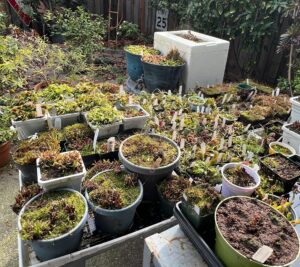
Dionaea muscipula, the Venus Flytrap, is a temperate plant that requires a winter’s rest or dormancy. But it still needs to be watered via the tray watering method and kept cool (outdoor Bay Area Winter temps are perfect).
Our climate is mild in winter but still cool, with lows in the 30s for a few days to a couple of weeks during winter overnight temps. During the days, it still gets up to the 40s on the cooler days so they never stay frozen.
Those of us living in the San Francisco Bay Area have a very easy time taking care of Venus Flytraps as long as they have their 3 main winter requirements met.
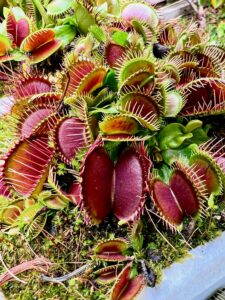
Three Requirements Over Winter
- Water
- The biggest thing to watch out for during the winters here in the Bay Area are the water trays they sit in. I use a heavy duty 1020 tray (10” x 20”) (and I have an outdoor table big enough to hold 9 trays). In winter, after the first rains fall, I use my, what I call “Winter Trays” that have a hole I drilled in one side about 1” above the bottom of the tray. When it rains, it will overflow out of this hole, flush out the tray of any built up salts or minerals, and, more importantly, keep the rhizome from sopping wet conditions.
- Once the last of the Spring showers stop in March or April (sometimes even May), I’ll then swap out my “Winter Trays” for my “Summer Trays” that have no holes in them. The water gets used up so fast by the actively growing plants and from evaporation in the warmer weather, having a full try of water only lasts a day or two before more than half of the water is gone.
- Sunlight
- Or more importantly, a shorter photoperiod. In the wild where Venus Flytraps naturally occur (in Eastern North and South Carolina), the winters a cold but not excessively freezing and the total daylight hours are about 9-11 hours. As opposed to about 13-14 hours of sun in the Summer.
- The shortened photoperiod tells the plants to go to sleep. Time for dormancy where the plants store up energy in their rhizomes and wait for the longer daylight and warmer temperatures the following Spring to start growing.
- No Fussing
- It’s super tempting to do all kinds of clean up on the plants. If you have a small collection, that’s usually not a problem. But if you have tables of Venus Flytraps, you’re probably not going to have time to pull out all the dead traps. No worries. It’s perfectly fine to leave the dead leaves on the plants over winter. Pull ‘em out when you can. Plus, by the time January rolls around, the pile of dead leaves can be simply grabbed a handful at a time and most of them will easily come out.
- But be careful because you can accidentally pull out a whole rhizome!
- It is, however, a great time to weed your pots. They stick out like sore thumbs and pulling them out is pretty easy.
- It’s super tempting to do all kinds of clean up on the plants. If you have a small collection, that’s usually not a problem. But if you have tables of Venus Flytraps, you’re probably not going to have time to pull out all the dead traps. No worries. It’s perfectly fine to leave the dead leaves on the plants over winter. Pull ‘em out when you can. Plus, by the time January rolls around, the pile of dead leaves can be simply grabbed a handful at a time and most of them will easily come out.
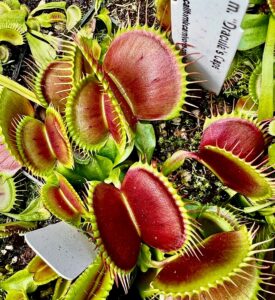
End of Winter Care – Preparing for Spring Growth
For me, this is around the end of February. Not quite spring but things are starting to change significantly. The days are noticeably longer, the temps are maybe a tad warmer overall, but the plants are still in dormancy. This is the perfect time to repot, divide, or up-pot your plants. They will have minimal problems from transplant shock because they’re mostly asleep. When they start to emerge from dormancy in March (in some colder states, this doesn’t happen until April), they’ll just wake up and start growing as if nothing happened!
- Assess Which Plants Need Repotting or Dividing-
- During the last half of February, the first thing I do is look at which plants absolutely need a repot/divide. If they are new plants from the previous couple of seasons, their rhizomes are likely pressing against the pot and threatening to pop the pot open. These 100% need to be repotted into a bigger pot or divided.
- Those that are literally breaking through their pots, you’ll have to make a decision – repot up in a bigger pot or divide.
- There are reasons to divide – to make more plants for yourself or to sell.
- Reasons to pot up to a bigger pot – If you want a naturally big colony of plants, this is the way to do it.
- What kind of pot should be used when potting up to a bigger pot? There’s a bunch of ways to think about this.
- You can go big with a bog pot which is a large container without drainage holes at the bottom, a layer of pumice or other neutral rock at the bottom, and then whatever potting medium you prefer. Add in a PVC snorkel down through the rock layer to allow air into the pot and as a way to water it as well.
- Tall hydroponic pots (the white ones with all the holes on the sides, corners and underneath) feel like they were made for Bay Area Venus Flytrap growers. 1) They’re white and won’t absorb excess solar heat and generally stay cooler on hot summer days. 2) They’re tall 7” for the mediums and 10” for the large pots. This gives Venus Flytraps tons of room for root growth downward. I find my plants generally look better, grow bushier, and overall seem happier in these taller pots.
- Switch out your Winter trays (hole drilled in one side 1” above the bottom) for your summer trays (no holes). The reason I do this is to allow for more water to stay in the trays during the summer months. I find that if I left my Winter trays in, I’m watering the trays twice a day as opposed to every 2-3 days.